
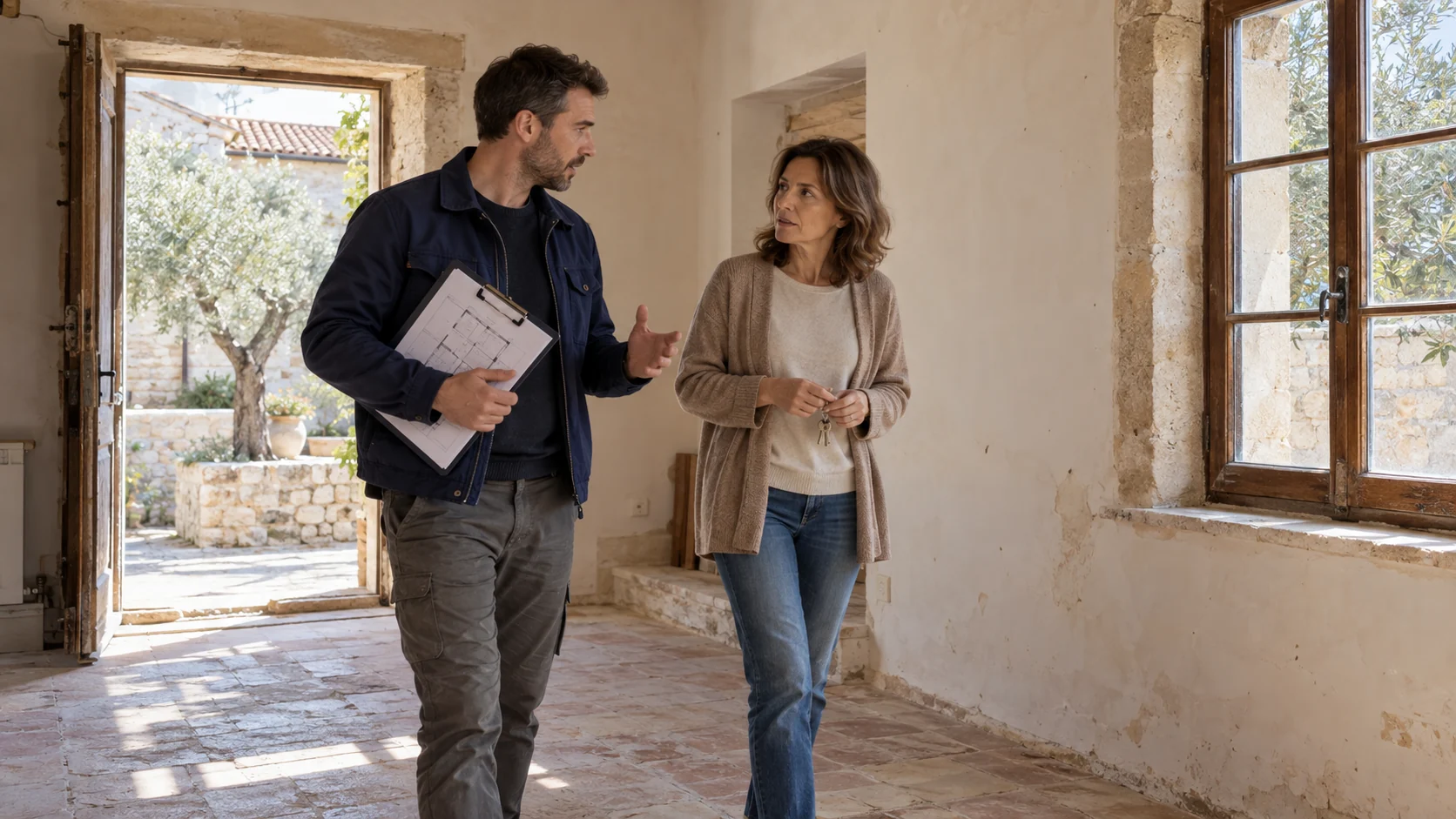
Before returning abroad, agree the scope of work with your contractor, photograph the property's existing condition, remove or protect valuables, arrange access and settle how materials will be purchased and delivered. Decide who can approve additional work, how changes will be confirmed and who will attend the final inspection.
You have come to Istria for a few days to arrange a house or apartment renovation. You have found a contractor, discussed the work and are about to return to Germany, Austria, Slovenia or wherever you live. The team is due to start after you leave. Renovating a property in Istria while living abroad.
The furniture that should have been removed is still in the room. The bathroom fittings have not been chosen. The contractor does not know whether the water can be shut off. A delivery arrives when nobody is there to receive it. By then, you are hundreds of kilometres away.
Walk through the property with your contractor before you leave
If you can visit Istria before work starts, make time for a joint inspection. Pointing to a room and saying “I want everything new” is not enough.
For a bathroom, establish whether the fittings will stay in their current positions, whether pipes and wiring will be replaced, what type of shower you want and what will happen to the existing floor. For a kitchen, check the positions of water, drainage and appliance connections.
If you want to change the layout, the feasibility of the alterations and the necessary documentation must be checked before they are carried out. Above all, you and your contractor need to mean the same thing when you describe the agreed work.
You may understand “a complete renovation” to include new plumbing and electrics. The quote may cover only removing and replacing finishes. If that difference emerges once work starts, a quick walk around the property is no longer an option.
Photograph the existing condition
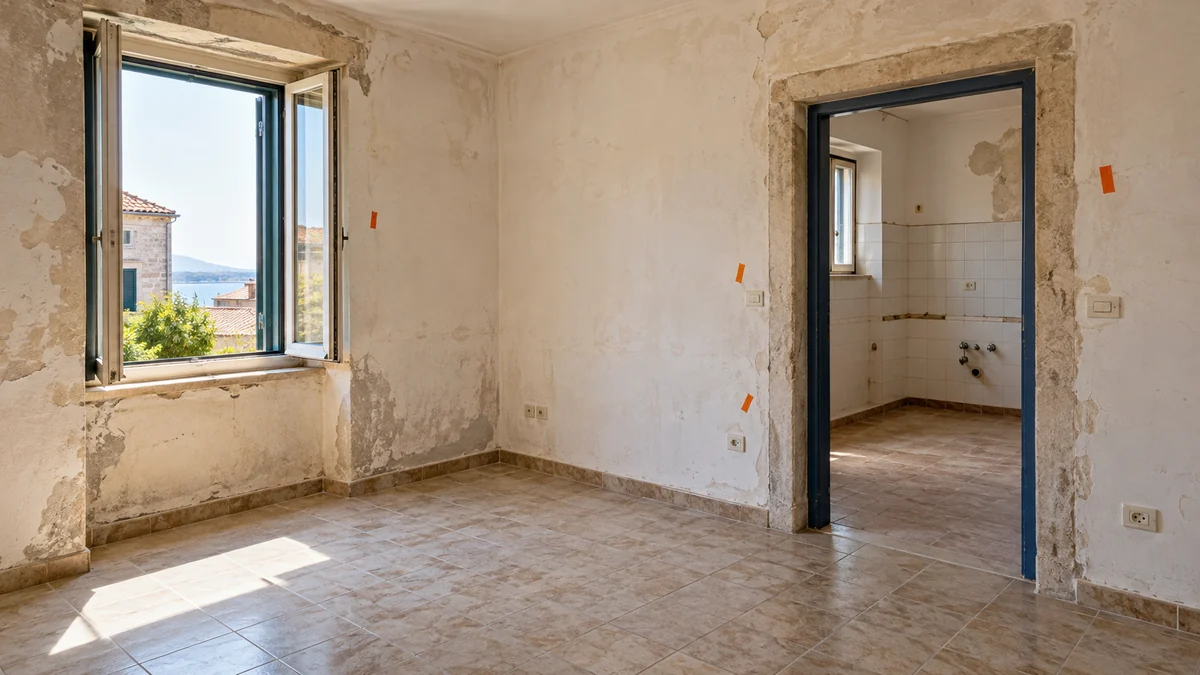
Before dismantling or demolition begins, record the property as it stands. Take wide shots of every room, then photograph details relevant to the work: existing damage, floors, walls, windows, doors, visible services and anything that will remain.
Suppose a door that is being retained appears damaged during the renovation. A clear photograph taken beforehand makes it easier to establish whether the damage was already there.
Photographs are useful when walls and floors are opened up, too. If removing tiles reveals a damaged substrate, the initial record helps everyone understand the condition and discuss any additional work. It does not replace photographs of what is uncovered.
For a larger renovation, I recommend a simple condition record. It need not be lengthy, but it should clearly identify what stays, what is removed and any existing defects.
Remove valuables and agree how everything else will be protected
Renovation brings dust, noise, deliveries, waste removal and people moving through the property. Even work in a single room can spread dust elsewhere in the house.
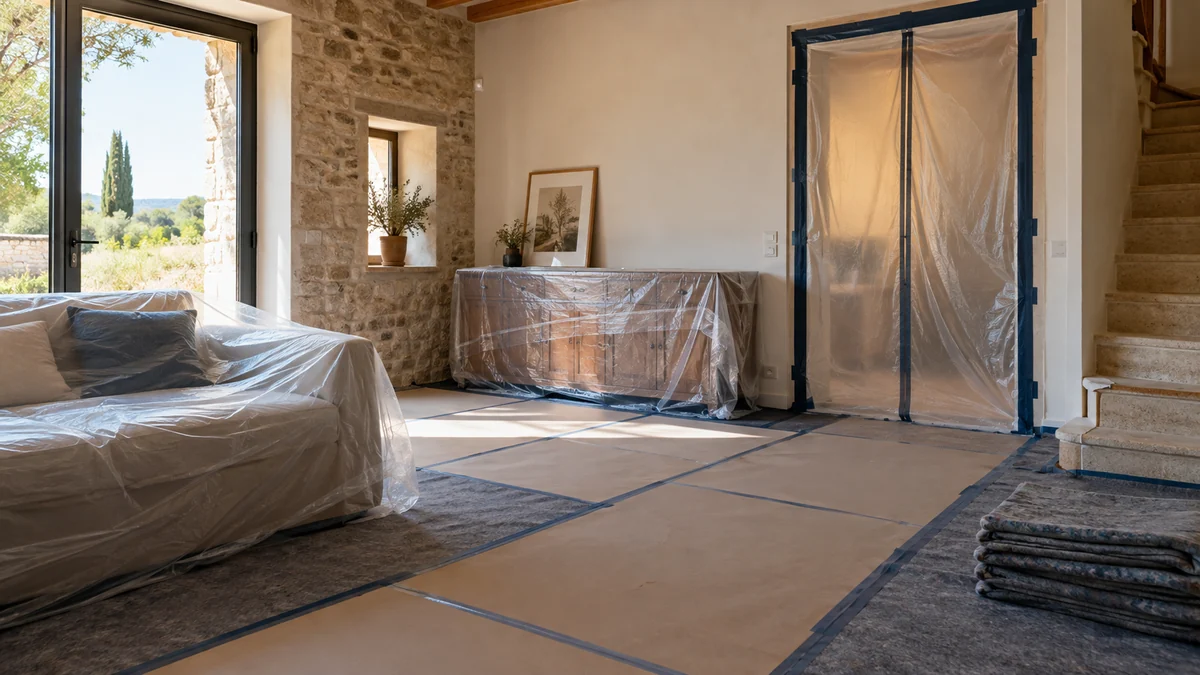
Remove valuable and delicate items wherever possible. Agree protection for anything that remains. A timber floor that is being retained, for example, needs protecting before tools and materials are brought in.
For a substantial renovation, also decide where furniture will be stored temporarily. Moving everything into another room will not help if that room is needed as a route through the property or for storing materials.
Protection of existing surfaces should be part of the agreed scope. The quote should make clear what is protected, who does it and whether the protective materials are included.
Make the key handover specific
For an owner living abroad, access is one of the most important practical arrangements. Agree who holds keys, when the contractor can enter and who will open up for other trades or deliveries.
If the property has an alarm, arrange a secure access procedure in advance. Do not assume your main contractor automatically takes responsibility for everyone who enters.
If you have separately appointed an electrician, joiner or equipment supplier, identify who coordinates their visits. Record how many keys have been handed over and how they will be returned when the work is complete.
For a property that is usually empty, nominate a local contact who can attend if a problem needs someone physically present. They do not need to make technical decisions; their role simply needs to be clear.
Check water, electricity and other services
Do not automatically switch everything off before leaving if the work requires those services. Renovation often needs power, water and adequate lighting. Equally, that does not mean leaving all services running without oversight.
Agree what the team will need, where the main shut-off valves and electrical protective devices are, and who is responsible for using them safely. Where plumbing or electrical installations are being replaced, the relevant trades should determine the necessary isolation and reconnection arrangements.
In an older property, do not assume existing connections and services are suitable for the planned work. Their condition may need a further check before work begins.
Settle decisions that affect the work
Waiting for an owner's decision is a common cause of delays. The tiler is ready, but the tiles have not been chosen. The plumber needs to prepare connections, but the concealed tap model is still undecided. The electrician needs to close up the wiring, but socket positions have not been approved.
Resolve these decisions before leaving Croatia. You do not have to choose every decorative detail, but anything affecting service positions, dimensions, heights or the sequence of work should be agreed before that stage is carried out.
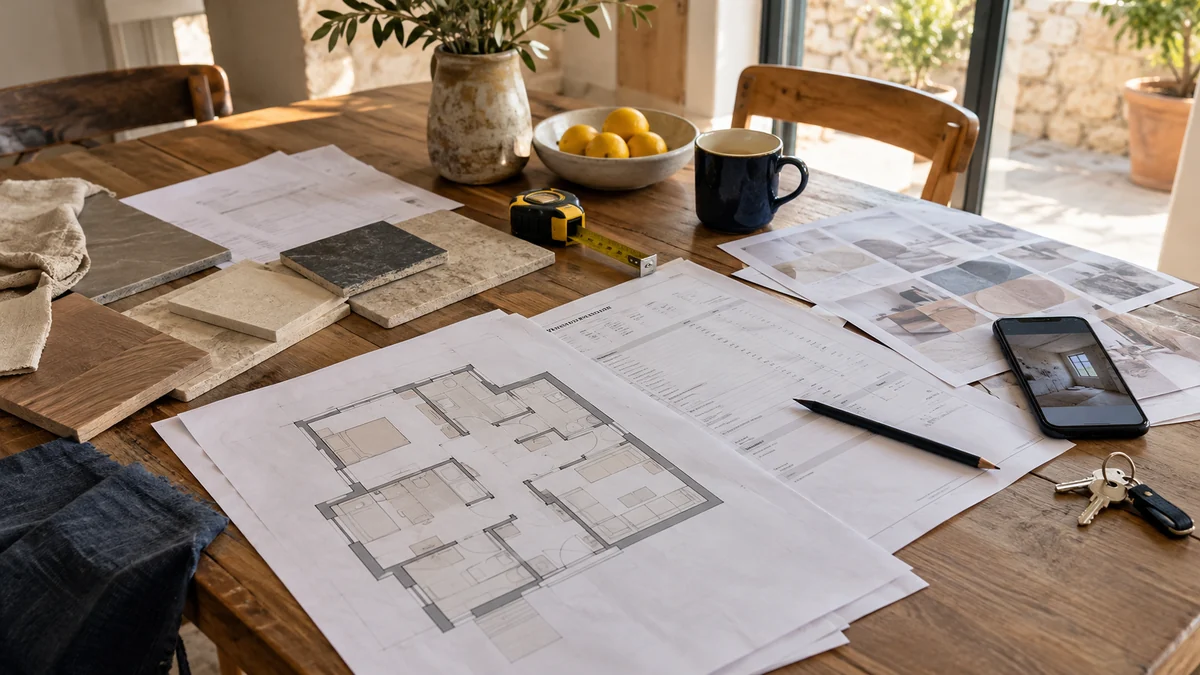
For a bathroom, this includes shower screen dimensions, drain positions and the fittings to be installed. A catalogue photograph is not always enough. Preparing connections often requires the exact product model and its technical documentation.
Who buys and receives the materials?
If you are buying tiles, sanitaryware, lighting or other products yourself, arrange how they will reach the property. Confirm the delivery address, timing, unloading arrangements, receiving person and storage space.
Do not assume the contractor will receive every order you place independently. They may be working elsewhere on site or unable to organise unloading at that time.
For fragile equipment, agree an inspection on delivery. A damaged shower screen is better discovered when it arrives than when the installer is ready to fit it.
Pay particular attention to products with long lead times. Missing materials can stop a job even when the team is ready to continue.
Check building rules and notify neighbours
If your apartment is in a shared residential building, planning the work also involves other owners and occupants. Under Croatia's building house rules regulation, NN 86/2025, they must be appropriately notified at least two days before work begins in an individual unit.
The regulation also sets the usual permitted working times, with specified exceptions and scope for different arrangements by a co-owners' decision. Check the rules for your particular building and agree how the notice will be given before you leave.
For work during the tourist season, also check local restrictions for the location and type of work. Poreč, Rovinj, Umag and neighbouring municipalities do not necessarily have identical rules. Do not assume every kind of work can take place at the same times throughout the year.
Plan deliveries and construction waste removal
In Istria's old town centres, access can be a significant part of the job. A delivery vehicle may not be able to reach the entrance through a narrow street in Poreč or Rovinj. That affects carrying in materials, removing waste and organising labour.
Before leaving, establish where unloading is possible, whether a particular parking space can be used and how construction waste will be removed. If placing a skip or occupying public space requires permission, obtain it before that space is used.
What happens if a hidden problem is found after you leave?
Not every condition behind a finish can be seen in advance. Once it is removed, the existing screed may prove too weak, or part of the services may need additional repair.
That does not automatically mean the contractor's initial assessment was wrong. Nor does it mean any additional work can be carried out and charged without prior agreement.
Define the procedure before work begins. For each unforeseen issue, you should receive a description, photographs, a proposed solution and an explanation of the effect on cost and timing.
Additional work should proceed after it has been agreed and approved, except where an urgent safety measure is necessary. This matters particularly when you cannot visit the site yourself.
Identify which stages are ready to start
Not everything has to begin on the same day. Some stages may require further measurements, material selections or technical checks.
For structural alterations and other work requiring design documentation or the relevant approvals, do not proceed on the assumption that it is “just a renovation”. Check the documents and whether the work is permitted for that specific property and scope.
If an important decision is outstanding, mark that stage as unresolved rather than leaving the contractor to improvise. A useful programme distinguishes work ready to start from work still awaiting prerequisites.
Your checklist before leaving Istria
- Has the contractor inspected the property, and is the scope clear?
- Have you photographed its existing condition?
- Is everyone clear about what stays and what goes?
- Have you agreed protection for furniture and existing surfaces?
- Are keys and access arrangements settled?
- Are the main shut-off valves and electrical protective devices identified?
- Have decisions affecting services and dimensions been made?
- Is it clear who orders, pays for, receives and stores materials?
- Have vehicle access, waste removal and building rules been checked?
- Have communication, approval of additional work and the final inspection been agreed?
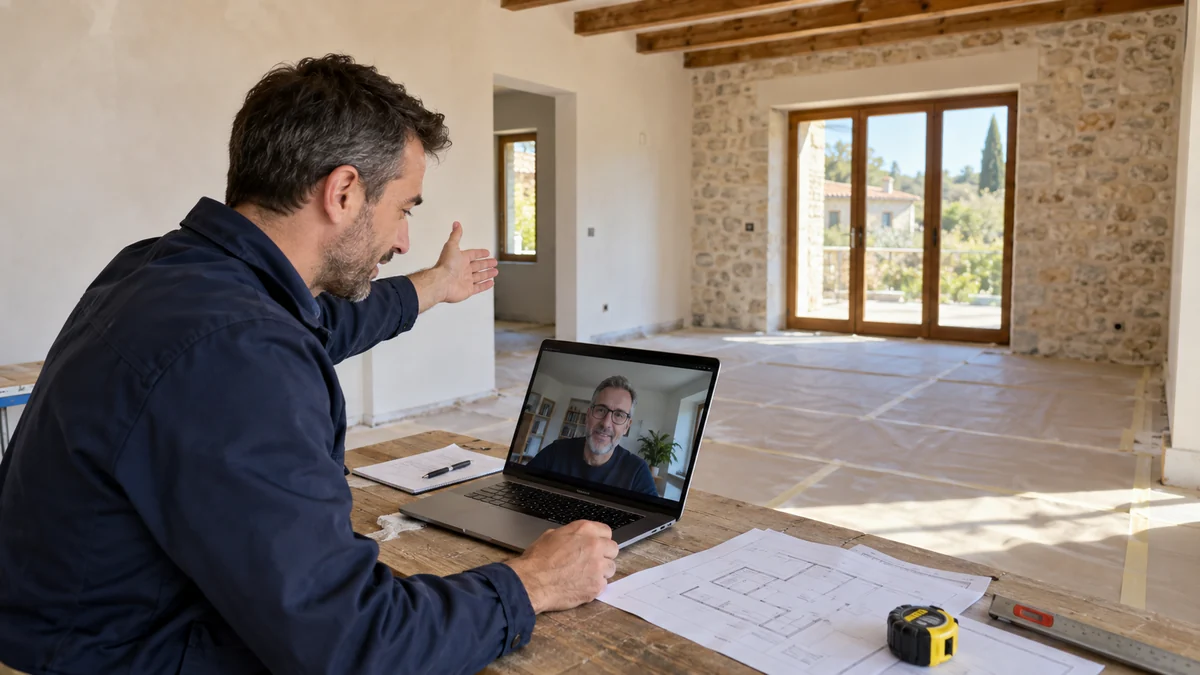
Can a renovation start while the owner is abroad?
Yes, provided the prerequisites are in place and responsibilities are clear. The owner does not have to be present for every everyday site decision. The contractor does, however, need the appropriate documentation, access and an agreed way to communicate.
You need to know which decisions require your approval and when. Distance is often manageable; a decision that only reaches you once the team is waiting is much harder to manage.
Planning a renovation in Istria?
If you live abroad and want to renovate a house, apartment, holiday property or villa in Istria, we can start discussing it before you visit.
Send the location, approximate floor area, a few photographs of the existing condition and a brief outline of what you would like to change. Tell us when you expect to be in Istria and when you will return abroad.
That will help us establish what can be clarified beforehand and what needs an inspection at the property.
Željko Maronić, ing.građ. — BUILD GRUPA d.o.o.
Frequently asked questions
Can I start a renovation if I do not live in Croatia?
Yes, if access, the necessary documentation, responsible people and communication arrangements can be put in place. Some work requires additional professional checks or documents before it can proceed.
Is leaving the contractor a key enough?
No. You also need to agree the scope, protection of existing property, receiving materials and how decisions about changes will be made.
Do I need to empty the whole house?
It depends on the work. An empty property often makes a full renovation easier to organise. For partial work, some belongings can stay if protection and access to working areas are agreed in advance.
How do I approve additional work from abroad?
Before it is carried out, agree what is needed, why, how it will be charged and whether it affects the programme. Confirm the agreement in writing wherever possible.
Do I have to attend the handover in person?
Attending is useful, but another inspection arrangement can be agreed. The person inspecting needs to be able to check the actual work and operation of the property, rather than simply view photographs.
What if the apartment renovation is planned for the tourist season?
Before fixing dates, check local decisions, the type of work, building rules, any guest bookings and actual access conditions. Restrictions vary by location and type of work.