
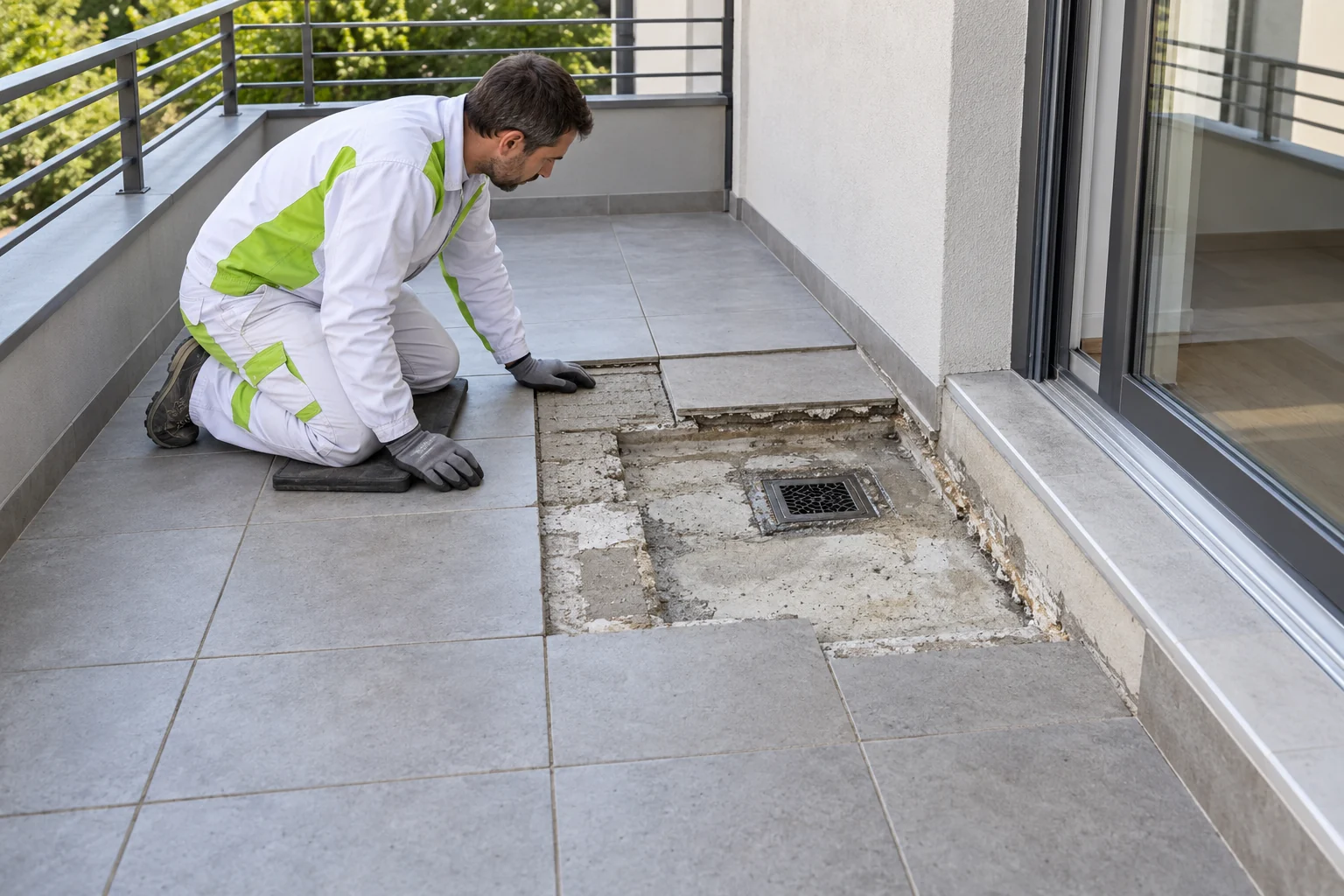
There is no single best terrace waterproofing system. The choice depends on the existing substrate, cracks, falls and drainage, threshold height and whether the finish will be tiles or an exposed membrane. Existing tiles can sometimes remain, provided they are stable and the selected system permits this application.
A solution that makes sense on a new cement screed is not necessarily suitable for a terrace with old tiles. A system intended to remain exposed and walkable differs from waterproofing that will receive a new tiled finish. A terrace with adequate falls and a sound substrate presents a different problem from one where water pools beside the threshold and the tiles already sound hollow.
Only then should you choose the waterproofing. See Waterproofing in Istria for an overview of the work.
The short answer
For a terrace refurbishment, I would make the decision in this order:
existing substrate → cracks and debonding → falls and drainage → thresholds and other details → desired finish → compatible waterproofing system.
Do the existing tiles need to be removed first?
Some waterproofing systems can be applied over a suitable existing ceramic finish, in accordance with the manufacturer's technical documentation.
Sikalastic-612 (02/2025, 07.01) lists unglazed tiles and suitable primers. The actual substrate’s soundness, preparation and compatibility must be checked.
If the tiles have debonded, the screed below is deteriorating, there are active cracks or the falls are inadequate, retaining the existing layer may mean building a new system on a substrate that is already failing.
Before deciding, check:
- whether the existing tiles are firmly bonded
- whether they sound hollow or are lifting
- whether cracks run through the finish
- the condition of the grout
- where water remains after rain
- how thresholds, edges and drains are detailed.
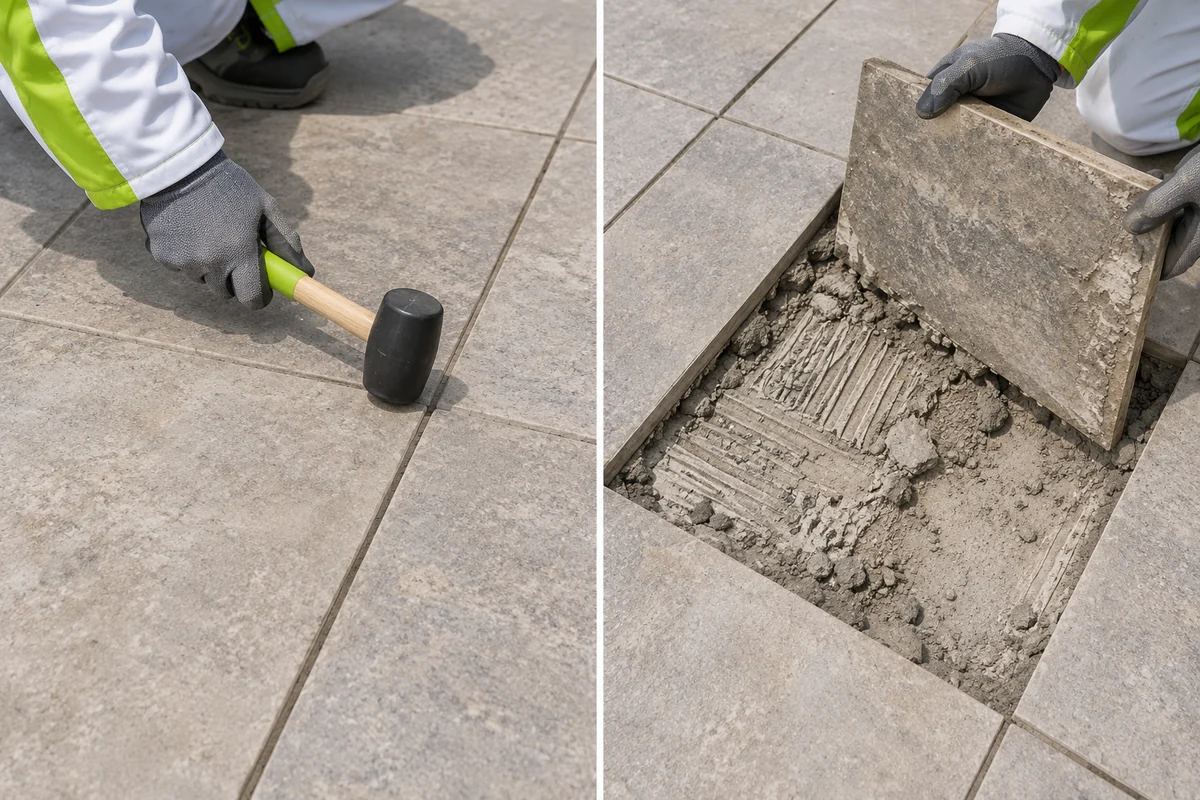
What if the tiles are sound but the terrace leaks?
If the existing finish is sound and stable, some systems allow refurbishment over it with suitable preparation and a primer.
This can reduce demolition work.
Where is the water actually getting in?
Critical locations can include:
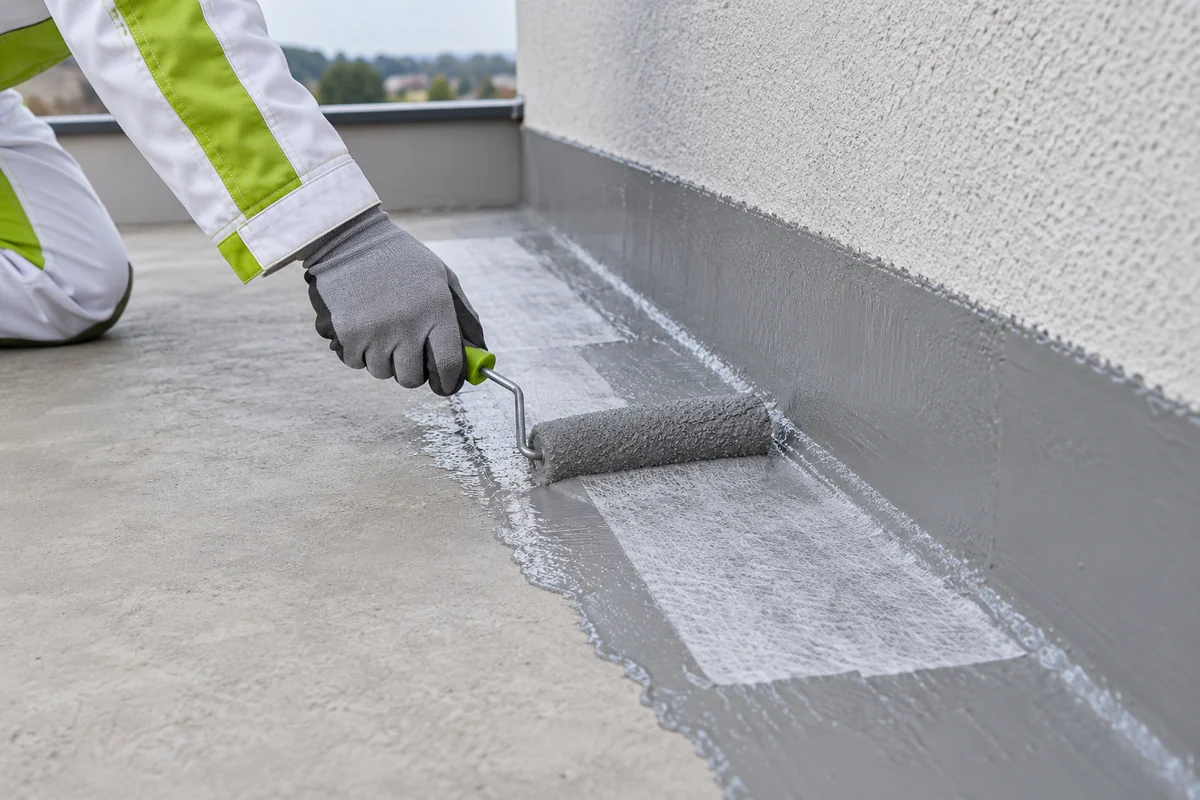
- the floor-to-wall junction
- the balcony or terrace door threshold
- the drain
- a railing penetration
- the terrace edge
- a movement joint
- a crack in the substrate.
If only the large horizontal area is treated and the actual entry point remains unchanged, the new waterproofing will not solve the problem.
Waterproofing does not correct inadequate falls
Waterproofing stops water passing through, but does not determine the direction in which it flows.
If puddles form or water flows back towards the threshold, first check the surface geometry and drainage.
In systems beneath tiles, the necessary falls should be formed before the final waterproofing, in the appropriate layer of the build-up.
A few millimetres of waterproofing coating should not be expected to correct a seriously uneven terrace or create falls where none previously existed.
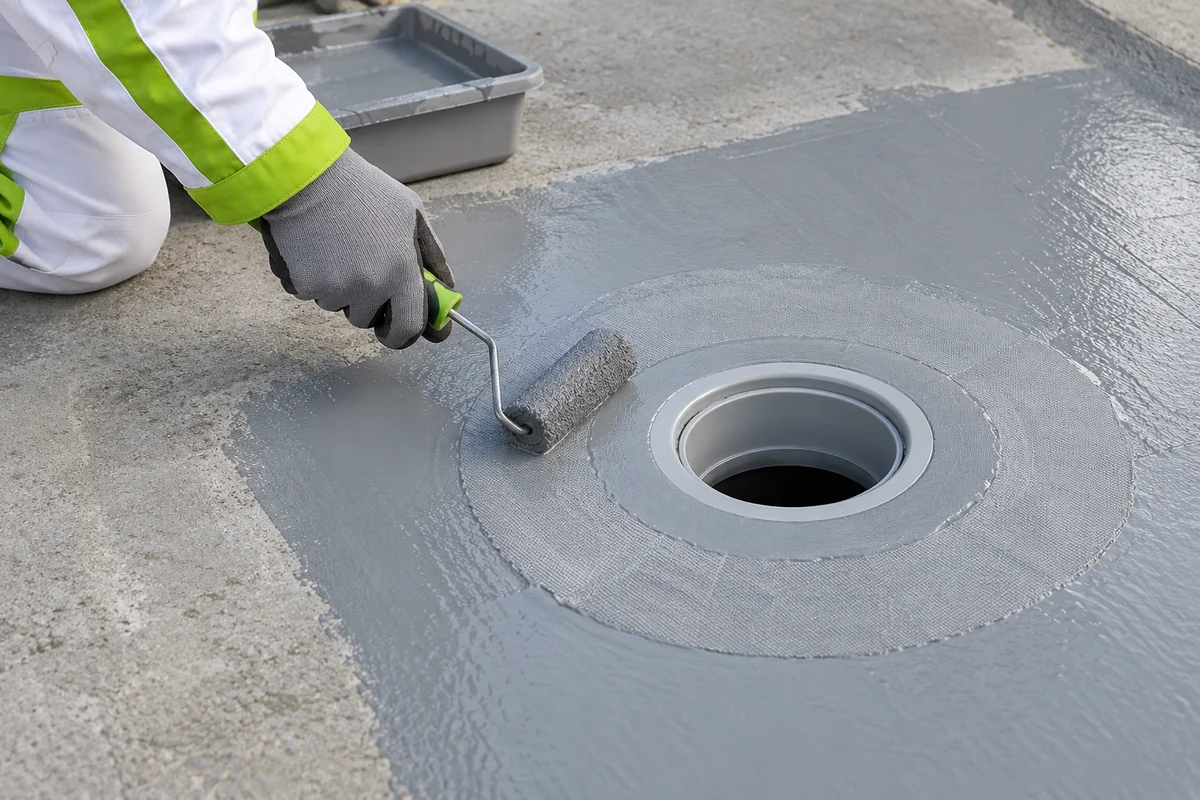
The drain is part of the waterproofing system
A refurbishment can look tidy yet still leak at the drain.
The waterproofing must connect continuously to the drain detail in accordance with the system used.
The same applies to corners, floor-to-wall junctions, service penetrations and movement joints.
It usually includes suitable tapes, collars, profiles or other components for locations where a plain, flat layer is insufficient.
Will tiles be installed over the waterproofing again?
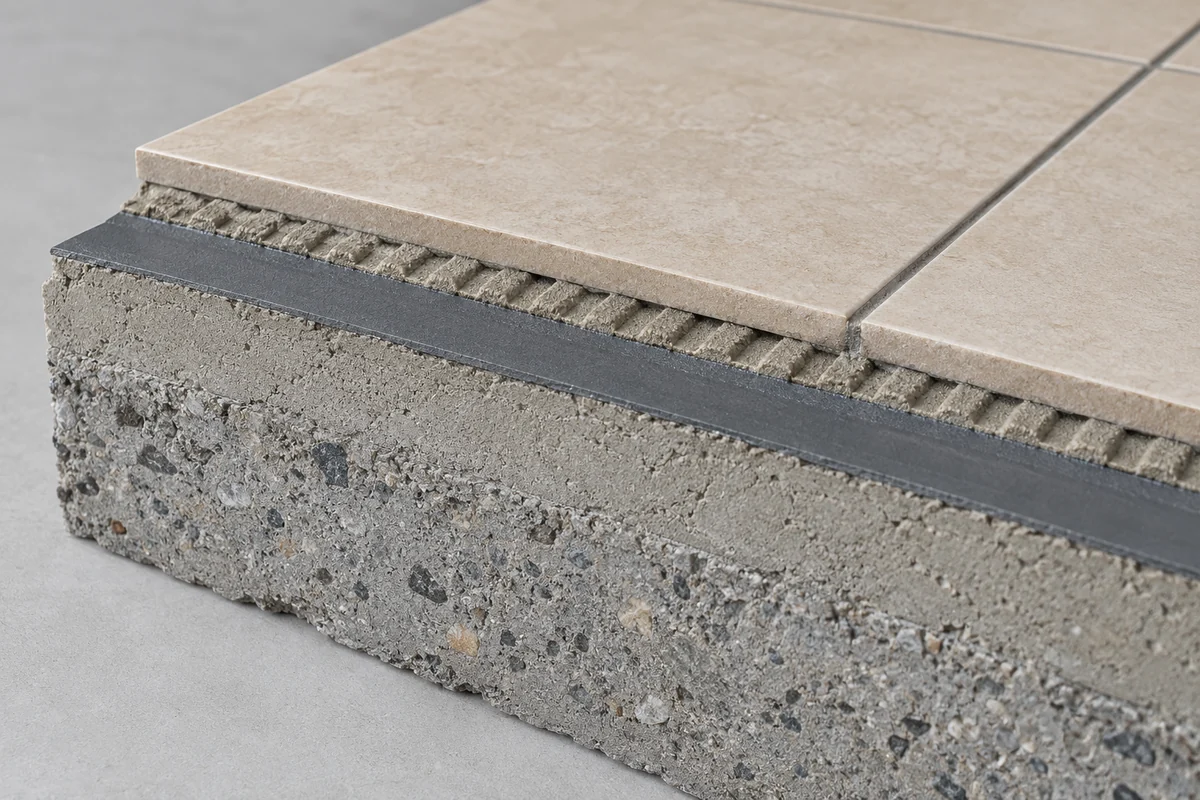
If you want new tiles, a waterproofing system designed for use beneath the finish is usually considered.
The substrate, waterproofing, adhesive and finish must all be compatible.
Ceramic tiles and grout do not replace the waterproofing.
Sikalastic-152 (04/2021, 02.02) is an example of waterproofing installed before ceramic tiles. It is not a specification for every bathroom or terrace.
This matters when refurbishing an old terrace: regrouting alone does not mean the waterproofing problem has been resolved.
What if you do not want tiles?
Systems in which the waterproofing is also the exposed finished surface can then be considered.
The products must be intended for that purpose: exposure to outdoor conditions, UV radiation and the expected mechanical loading.
UV resistance alone does not establish suitability for regular foot traffic. For example, Sikalastic-152 is not an exposed pedestrian floor without suitable protective paving.
Do not assume every liquid or cementitious waterproofing product can remain unprotected and serve as a finished floor.
Some systems must be covered by a finish, while others are designed as exposed membranes or coatings.
Cementitious waterproofing or a liquid membrane?
Both groups may be suitable, but they are not automatically interchangeable.
Flexible cementitious systems are often used on balconies and terraces beneath ceramic tiles or stone.
Liquid membranes use several technologies and can serve different build-ups: some beneath a finish, others as exposed finishing systems.
Uncoupling and crack-isolation membranes are also available where the substrate requires a different approach.
The entire build-up needs to be defined.
What if the screed is cracked?
An old, stable screed crack is different from a crack indicating active movement of the substrate.
Some waterproofing systems can bridge cracks, and special uncoupling membranes can reduce the transfer of stresses from the substrate to the finish.
Schlüter-DITRA, 6.1 describes an example of uncoupling. Waterproof installation also requires correctly sealed joints and transitions.
No product should replace diagnosis of serious structural movement.
If cracks change, return after repair or appear elsewhere in the building, establish their cause first.
What if the substrate is still damp?
Some products require a dry, sufficiently cured substrate.
Other manufacturers allow certain systems on substrates that are not completely dry, subject to specific conditions.
For example, Sikalastic-152 allows damp substrates and describes pre-wetting without standing water. Substrate preparation and drying before covering still apply. By contrast, Sikalastic-612 requires a dry substrate without rising moisture.
You need to know the substrate type, the cause of the moisture and the technical requirements of the system being considered.
Drying time, permitted moisture content, substrate preparation and application method should not be guessed.
Use the current technical data sheet for the selected system.
The door threshold often determines the space available
When refurbishing an existing terrace, one of the first things I would measure is the finished surface level relative to the door threshold.
Every new layer takes up height:
the existing substrate, any levelling layer, waterproofing, adhesive and finish.
Adding new layers over old ones without checking the available height can bring the surface too close to the threshold or cause a problem at the transition to the interior.
A large terrace is more than an enlarged small balcony
As the area increases, falls, movement joints, drainage and substrate behaviour become more important.
A large terrace may have more drains, more structural joints and greater thermal stresses.
A solution that works on a small balcony of a few square metres should not automatically be transferred to a large roof terrace.
How I would assess an existing terrace
Before preparing a quotation, I would first try to answer:
- What is currently on the terrace?
- Are the existing layers sound and stable?
- Are there cracks or debonding?
- Where are the effects of water ingress visible?
- How does water leave the surface?
- What is the condition of drains, thresholds, edges and penetrations?
- How much height is available for new layers?
- Does the owner want tiles, stone or an exposed membrane finish?
When would I retain the existing tiles?
The finish must be stable, the substrate sufficiently reliable, the details capable of being properly completed and the heights suitable for the new system. The manufacturer must explicitly permit this application.
When would I open up the existing layers?
If the problem may lie beneath the surface, demolition can be more rational than another surface repair.
Typical reasons include extensive tile debonding, poor or cracked screed, problematic falls, unknown layers, multiple previous repairs or details that cannot be properly resolved without opening them up.
Choose the system after inspection
“Which waterproofing system suits this substrate, these details and the finish I want?”
If a terrace or balcony leaks, useful photographs for an initial assessment show the entire surface, thresholds, edges, drains and where the effects of water ingress are visible. Include approximate dimensions and say whether you want to retain the existing tiles or install a new finish.
This helps identify what needs further checking. For more complex refurbishments, the final solution should be determined after an on-site inspection. For local enquiries, see Waterproofing in Poreč.
Željko Maronić, ing.građ.
BUILD GRUPA d.o.o.
Frequently asked questions
Can waterproofing be applied over existing tiles?
With certain systems, yes, provided the existing finish forms a sufficiently sound, suitably prepared substrate. If tiles have debonded or the layers beneath are problematic, retaining them merely to avoid demolition does not make sense.
Are tiles and grout waterproofing?
They should not be treated as a substitute for a designed waterproofing layer. In tiled systems, waterproofing is installed in the appropriate layer beneath the finish.
Does the entire old terrace always need removing?
No. The extent of removal depends on the existing substrate, heights, details and the system being installed.
Can waterproofing correct inadequate terrace falls?
A waterproofing coating does not replace substantial correction of the surface geometry. The necessary falls must be formed in the appropriate layer before completing the system.
Is a liquid membrane better than cementitious waterproofing?
Neither is universally better. The choice depends on the substrate, whether the membrane will remain exposed or be covered, application conditions and the manufacturer's requirements.
Why can a terrace leak even when the tiles look sound?
Water ingress may occur at junctions, the threshold, drain, edge or a penetration rather than in the middle of the tiled surface.
What should I photograph first for a repair assessment?
The whole terrace, the water ingress location, thresholds, drains, edges, cracks and areas where tiles or grout appear damaged.
Planning a terrace refurbishment?
Send photographs of the surface, thresholds, edges and drains, approximate dimensions and your preferred finish.
Send an enquiry ↗