
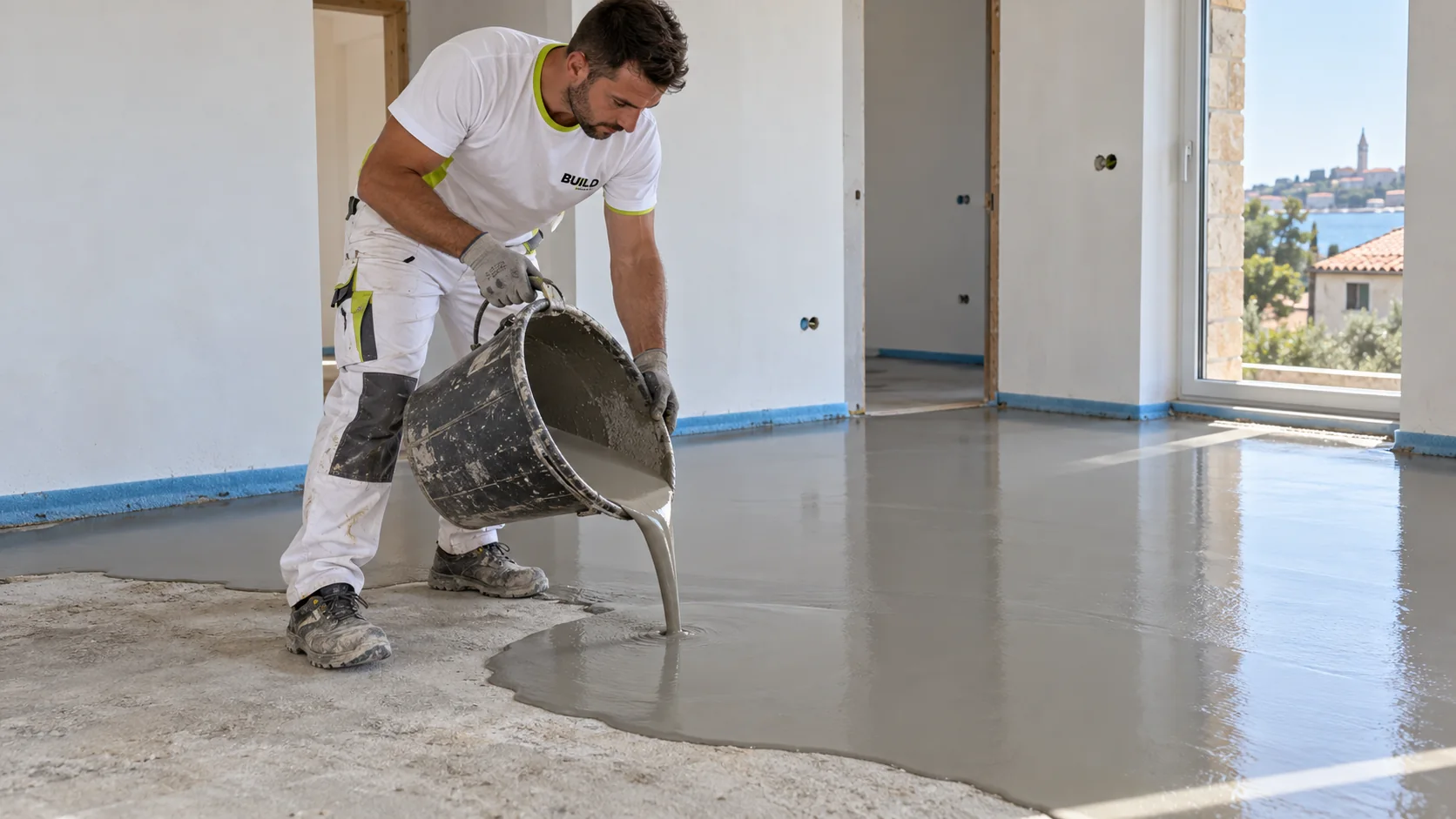
You have chosen the flooring for your home in Istria. Once the old finish comes up, the contractor suggests a self-levelling compound. Is that an essential part of the job or an extra you can avoid?
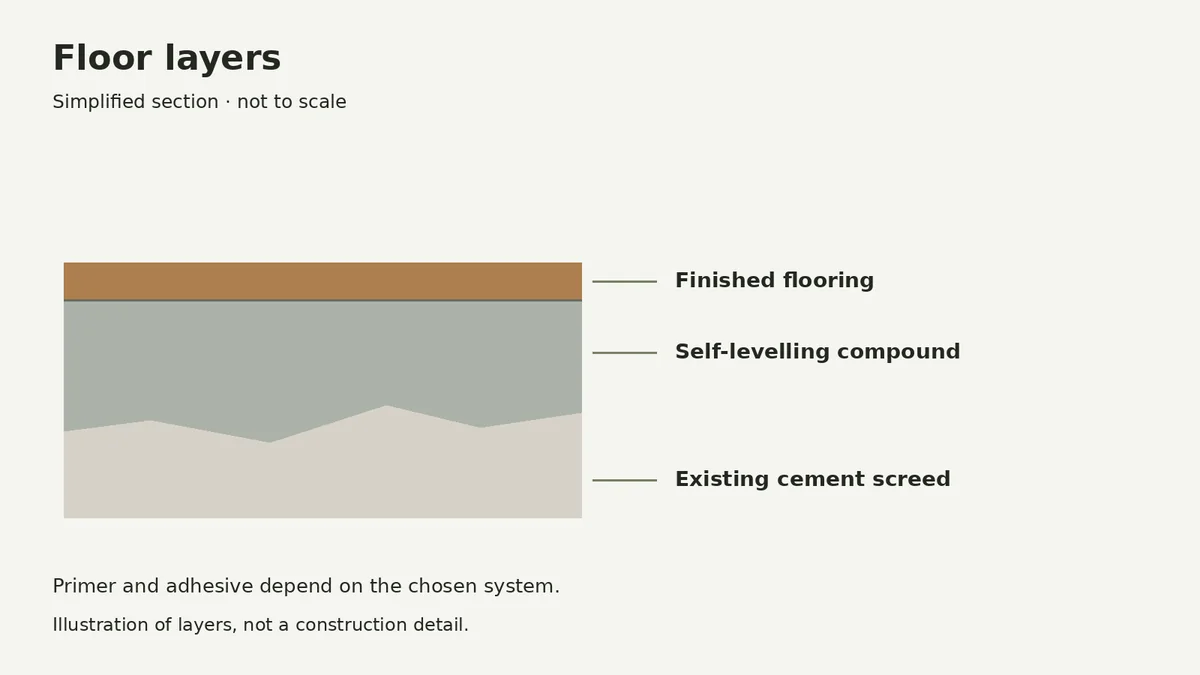
It depends on the substrate and the flooring you have chosen. A levelling compound is useful when a sound substrate does not meet the finish manufacturer’s flatness requirements. If the existing floor is already flat enough, stable and suitably dry, another layer may be unnecessary.
For an owner organising a renovation from abroad, the useful question is: what has been measured, and what needs correcting? A compound cannot make a crumbling or loose screed sound.
Flat does not always mean level
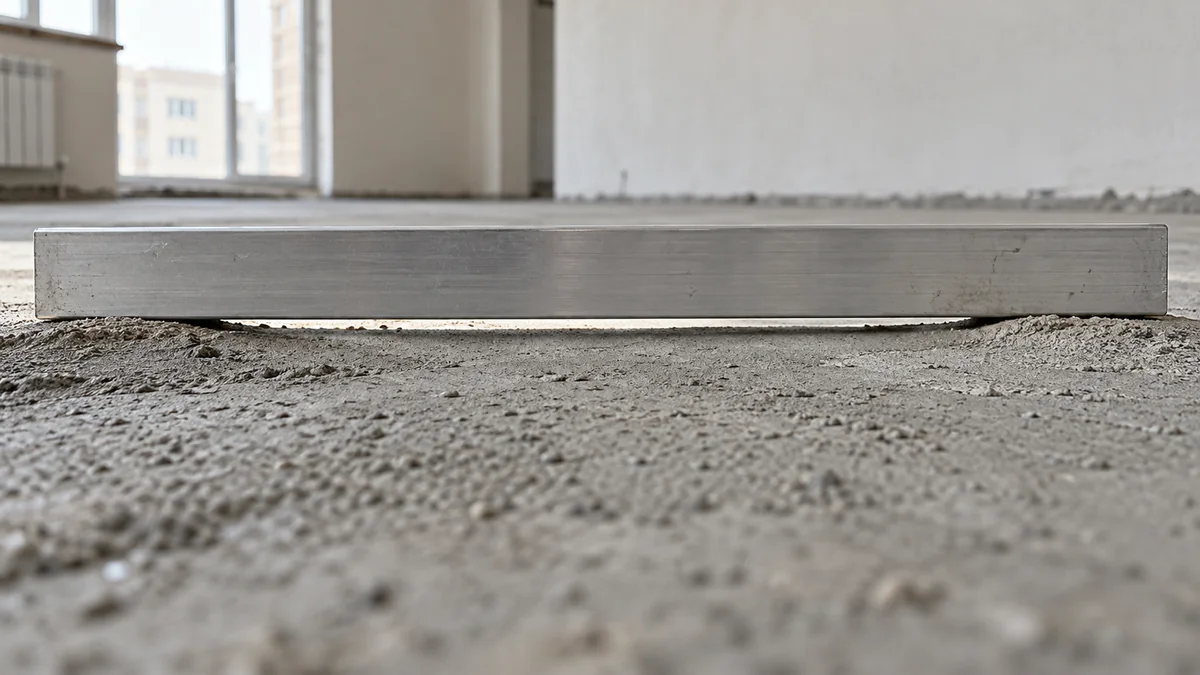
A floor can be flat and still slope slightly. It can also be broadly level but have small dips and ridges. These local variations matter to a new floor: they can affect floating floor joints or show through glued vinyl.
Ask for a check of flatness against the requirements of your chosen product. Making every room perfectly horizontal is not automatically the goal. Where a fall is needed for drainage, it must be preserved.
When a levelling compound earns its place
Small hollows, old repair edges and surface irregularities can often be corrected on a strong, stable substrate. First establish the depth needed across the room, then choose a product suited to it.
Murexin specifies 1–10 mm for LINEA 803 SL and 3–40 mm for LINEA 830 SL. These are limits for those particular products, not rules for every compound. The quoted system should match the actual floor, rather than simply the number of square metres.
Technical data sheet: Murexin LINEA 803 SL · Technical data sheet: Murexin LINEA 830 SL
When the screed needs attention first
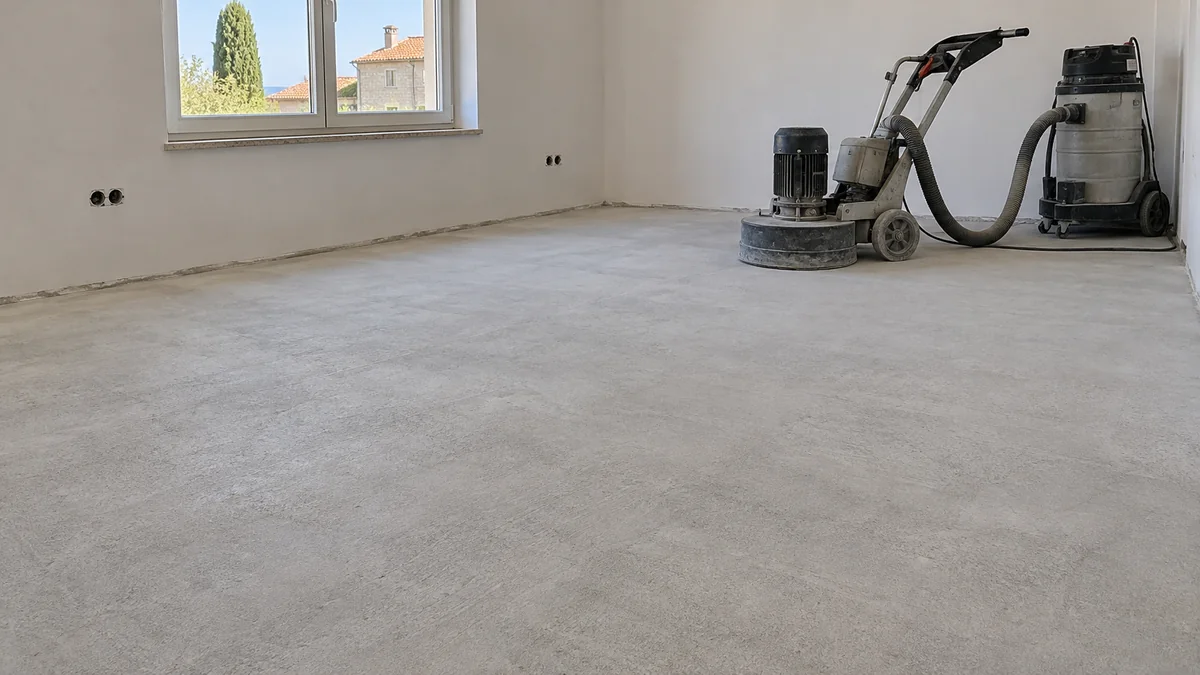
Loose areas, a friable surface or sections separating from the base need assessment before pouring. Covering them can leave the new layer attached to an unreliable substrate.
The LINEA 830 SL technical sheet calls for a dry, strong, load-bearing, dimensionally stable and clean substrate. Dust, debris and poorly bonded material must be removed. The inspection should establish whether local repairs are enough or more extensive replacement is needed.
Technical data sheet: Murexin LINEA 830 SL
Agree the finished floor heights
Vinyl in the living room, wood in the bedrooms and tiles in the hall will not necessarily produce the same height. Adhesive and other system layers also take up space.
Before levelling, agree the finished levels at doorways and between rooms. This affects doors, thresholds and skirting. Grinding isolated high spots may be more practical than raising the entire floor. A simple record of these heights is especially useful when you cannot attend the site.
Preparation and primer are part of the job
Most bonded levelling systems require an appropriate primer. Its role can include regulating absorption and helping the compound bond to the prepared base.
An absorbent cement screed needs a different approach from a low-absorption surface. The primer must be compatible with the substrate and compound. LINEA 830 SL’s instructions distinguish between absorbent and non-absorbent substrates; preparation should follow the selected system.
Technical data sheet: Murexin LINEA 830 SL
Walkable does not mean ready for flooring
A floor can feel dry while retaining too much moisture for the intended finish. Levelling does not automatically solve moisture in the existing substrate, and wood or vinyl may have specific acceptance requirements.
Sika’s Sikafloor Level-30 documentation separates foot traffic, waiting time before covering and the moisture conditions required by the finish. Thickness and site conditions affect drying. Agree the installation date on that basis, rather than the first day someone can walk across the compound.
Technical data sheet: Sika Sikafloor Level-30
Cracks and movement joints need a plan
A surface blemish and a crack caused by movement are different problems. Active cracks need their cause assessed and a suitable repair; simply pouring over them can lead to another crack.
Existing movement joints must not be casually filled to create a seamless-looking base. LINEA 830 SL’s instructions require them to continue through to the finished surface. The joint arrangement needs coordination with the final floor.
Technical data sheet: Murexin LINEA 830 SL
What about a whole apartment?
Two apartments of the same size can require very different amounts of compound. A 60 m² apartment might have shallow corrections in one room and much deeper work in another.
An estimate should therefore reflect the measured thicknesses and preparation, as well as area. If the substrate needs substantial rebuilding, a dry screed system may also be worth assessing. It is a different floor build-up, with its own height, load and suitability checks, rather than a direct substitute for a thin levelling layer.
What to ask for in the quotation
The scope should identify preparation and grinding, local repairs, primer, compound and the final flatness check. Confirm whether fitting the finished floor is included or a separate contract.
If you live outside Croatia, ask for photographs after the old finish is removed, a clear summary of the inspection and written agreement before additional work. An overseas purchase schedule or a planned arrival date should leave room for findings and drying, rather than assume the floor will be ready immediately.
A sensible next step
Keep a sound substrate where it meets the new flooring requirements; repair it where it does not. The decision should follow inspection, flatness checks, moisture assessment and the planned floor heights.
Send us the property’s location in Istria, approximate floor area, photos and the finish you want. We can identify what needs checking and whether a site visit is needed before preparing a quotation.
Questions property owners ask
Does vinyl always need a levelling compound?
No. It depends on whether the existing substrate meets the selected vinyl manufacturer’s requirements, including flatness.
Can it go over an old screed?
Yes, if the screed is sufficiently strong, stable, suitably dry and correctly prepared for the system.
Will it repair cracks?
Not by itself. The cause and condition of the cracks must be assessed and repaired as appropriate first.
How long before the finished floor can be fitted?
That depends on the product, thickness, drying conditions and flooring requirements. Foot traffic readiness is not enough.
Is it the same as a screed?
Not necessarily. A levelling compound commonly prepares an existing substrate; screeds can serve other functions. Check the intended use of the specific product.
Can it be used over underfloor heating?
Some products are suitable. Compatibility and the manufacturer’s heating instructions during installation and curing must be checked.
Željko Maronić, ing.građ.
BUILD GRUPA d.o.o.